Redmond, WA · Garage Door Service
Off-track garage door repair for Bainbridge Island homes, most built after 1989 on rollers and track hardware that outdates Redmond's older stock. Traveling crew from Redmond.
We run this job out of Redmond, about 18 miles from Bainbridge Island, so booking here works differently than it does for a customer five minutes from our shop. We're not swinging by on a whim between two other calls in the neighborhood - a Bainbridge Island job gets scheduled as its own trip, which means we ask a few more questions up front: is the door off the track on one side or fully derailed, is it a two-car door or single, can you get a flashlight on the rollers before we arrive. That lets us load the right rollers, track sections, and hardware the first time instead of driving back to Redmond mid-job. Median household income here runs higher than the broader service area average ($159,882 versus $139,152), and homes tend to be newer too, which usually means less improvising with obsolete parts and more straightforward stock replacement. Tell us the door's age and whether it's ever been serviced - that shapes what's in the truck when we leave Redmond.
An off-track door is not always a same-day fix once you factor in the drive. Because the crew is coming from Redmond rather than a local depot, plan around the trip time on top of the repair itself - we don't carry a local response-time promise for Bainbridge Island and won't invent one here. Most off-track jobs on a door built after 1989, which describes the bulk of the housing stock on this side, run on nylon or steel rollers in standard track - not the older hardware that turns a simple fix into a parts hunt. If the track is only bent or a hinge has pulled loose, that's usually one visit. If a cable snapped when the door came off the track, or the opener drive gear stripped trying to force a door that wouldn't move, that adds a step. We'll tell you on the phone which situation you're likely looking at before we load the truck.
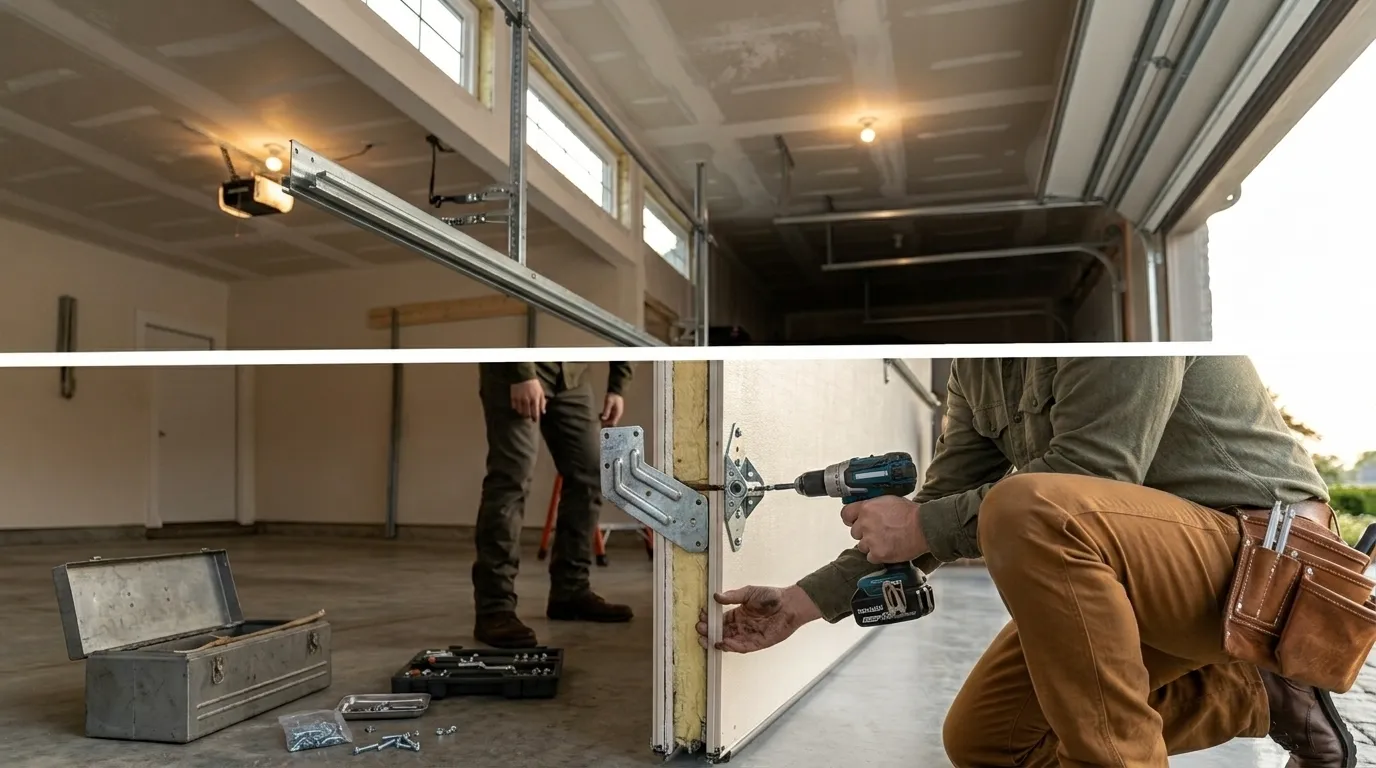
Getting a door back on track starts with figuring out why it left in the first place, not just muscling it back into the channel. On a door from the late 1980s or newer - which covers most of what's on Bainbridge Island, where the housing stock skews notably newer than the wider Redmond service area's 1965-to-2005 range - the track itself is usually in decent shape. The failure is more often a roller that's worn through its housing, a bent track bracket where someone backed into it, or a cable that jumped its drum. We realign the track, swap worn rollers, check the cable drums and spring tension before we ever run the opener, and test the door through a full open-close cycle under its own power, not just by hand. One honest limit: if the section of track is torqued badly enough that the metal itself is deformed rather than just knocked loose, we replace that section rather than bend it back - bent track that's been re-bent tends to fail again within a season.
With a median build year of 1989, most doors on Bainbridge Island are original-era steel sectional doors on standard roller track, not the older side-mounted torsion setups you'd find on a house from the 1960s. That's a different failure pattern than what we see closer to Redmond. The common cause here is a roller that's worn down after twenty-plus years without lubrication, riding rough in the track until it finally jumps the rail, or a track bracket that's worked loose from the framing over time. The region's cold, moderate climate plays a part too - freeze-thaw cycling loosens bolts and lag screws holding the track to the jamb faster than a mild climate would, and a slightly loose bracket is often the first domino before a door comes off the rail entirely. Storage clutter crowding the track, or a car bumper clipping the bottom section, accounts for the rest.
The job gets harder when someone's already tried to force the door back onto the track by hand or with the opener before calling. Running the opener against a jammed door is the single most common way a simple off-track roller turns into a snapped cable or a stripped opener gear - at that point we're doing two repairs instead of one. It also goes sideways when the track has pulled away from the framing on both sides rather than just one, which usually means the door was run off-track for a while before anyone noticed. With roughly 9,827 households on the island and a housing stock that's newer than much of the wider service area, we don't run into as much genuinely obsolete hardware here as we do elsewhere - but a door forced hard enough can still bend a track section beyond a simple realignment, and at that point replacement of that section costs more than the original fix would have.
We're based in Redmond, about 18 miles away, and don't keep a branch on Bainbridge Island. There's no local response-time guarantee here - a job gets scheduled as a dedicated trip, and we ask more upfront questions so we bring the right parts the first time instead of a return visit.
Usually easier. Most Bainbridge Island homes were built around 1989 or later, on standard roller track rather than the older torsion hardware found on 1960s houses. Parts for that era are common stock, not something we have to hunt down, so the repair itself tends to be more predictable.
Don't run the opener on it, and don't force it by hand past light pressure. Forcing a jammed door is the most common way a simple roller-off-track problem turns into a snapped cable or a stripped opener gear, which turns one repair into two.
Depends on what's actually wrong. A bent track or loose bracket is often a single visit. A snapped cable or damaged opener gear from forcing the door adds a step. Because the crew travels from Redmond, factor the drive into your timeline as well as the repair itself.
Call now or request a free quote - same-day service on most repairs, upfront written pricing.