Redmond, WA · Garage Door Service
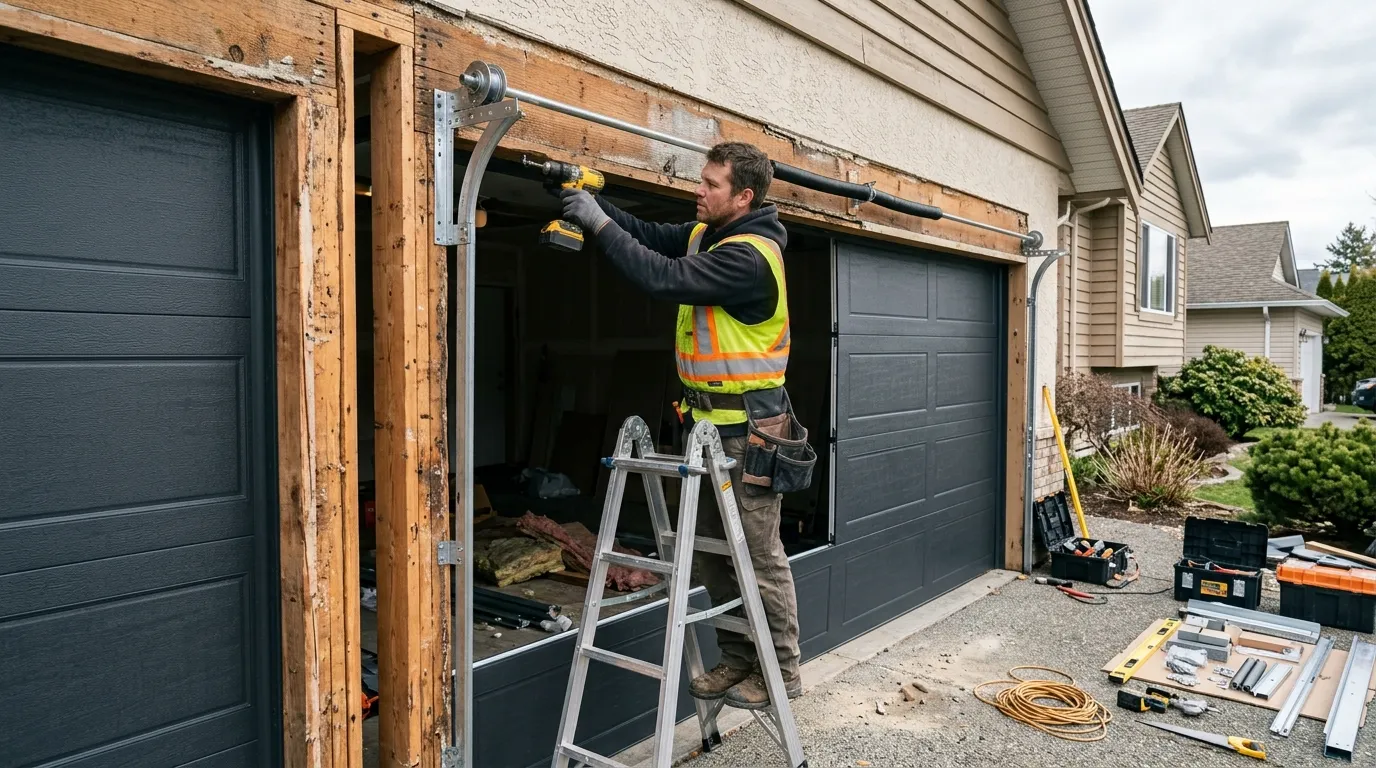
Panel replacement for Burien's 1960s-era garage doors. We travel from Redmond to match steel panel sections on houses built years before most of our service area.
Most of the houses we get called to in Burien went up around 1965, which puts them a full twenty years ahead of the 1985 median that describes the bulk of our territory. That matters for panel work because doors from that era were built as steel sectional units with panel profiles and rib patterns that manufacturers stopped making decades ago. Matching a single damaged section on a door like that usually means finding a panel with the same rib count, the same seam spacing, and a paint match close enough that it doesn't look patched.
On newer doors - the 1980s and 90s stock that makes up most of the wider service area - panel replacement is closer to a swap: pull the section, bolt in the same part number, done. On a 1965 door, we're often measuring panel height and rib spacing by hand because the door predates any part number we can look up. If the track and hinges are original too, we check those while the door is apart, since worn hinges on old steel panels tend to bend the new section the same way they bent the old one.
If one panel is dented but the rest of the door tracks straight, a single-section swap is within reach for someone comfortable with a ladder, a socket set, and unplugging the opener first. The part that trips people up on a house this age isn't the bolts - it's finding a panel that actually fits. Order the wrong rib pattern and you'll have a section that bolts on but doesn't sit flush, which throws off the roller alignment on every panel above it.
We won't pretend we always get an exact match either. On doors this old, sometimes the closest available panel is a near match, not a perfect one, and that's a conversation we have with the homeowner before any work starts, not after. If your door has two or more damaged panels, or the track is bowed, that's past a weekend job - misaligned track under load is how a cable lets go while the door's moving.
We don't have a set price to quote here - panel cost depends on whether we can source a close match to a 1965 rib profile or need to special-order one, and that varies job to job. What we can tell you is what drives the number: how many sections need replacing, whether the color needs matching, and whether the track and hinges are still sound enough to reuse. A door with one dented panel and straight track costs a lot less to put right than one where the panel damage is a symptom of years of misalignment. We'll walk the door with you and give you the number before anything gets ordered - not after.
This is a cold-climate service area, and steel panels that have been cycling through freeze and thaw since 1965 are past their prime in a specific way: the seams where sections meet start to flex, and that flex is what turns a minor ding into a panel that won't sit flat anymore. A dent that would stay a dent on a newer, stiffer panel spreads along an old seam instead.
The other pattern we see on houses this age is impact damage low on the door - a car bumper, a bike, a trash can - because these doors sit closer to grade than a lot of the raised-entry construction built after 1985. Combine an aging seam with a low-panel impact and you get a section that's cracked rather than dented, which usually means full replacement of that panel rather than a pull-and-straighten.
For a common panel profile we can source quickly, the door is back together the same visit. For a 1965-era rib pattern that has to be special-ordered, the door itself can usually still open and close in the meantime - we secure the damaged section so it's safe to operate - but the cosmetic fix waits on the part. We travel from Redmond to reach Burien, about 18 miles out, so scheduling the visit itself is part of the timeline too; we're not a branch office five minutes away, and we tell you that upfront rather than promise a window we can't hold.
Tell us the panel that's damaged, roughly where on the door, and if you know it, whether the door's original to the house. That's usually enough for us to start pricing a match before we even arrive. Since Burien sits toward the edge of the territory we run from Redmond, we schedule these visits rather than treat them as a same-day drop-in - we'll give you a window when you call, not a guess. You can see more about how we cover Burien, and if you're closer to Redmond itself, panel replacement details for that side of the territory are on our Redmond panel replacement page.
Often, but not always. Doors from the mid-1960s used rib patterns and seam spacing that current manufacturers don't produce anymore, so we look for the closest match available. We'll show you the option before ordering - sometimes it's a perfect match, sometimes it's a close one, and we'd rather you know which going in.
No. We run out of Redmond and travel to Burien, about 18 miles, so we schedule these visits rather than offer a same-day drop-in. Tell us what's wrong when you call and we'll give you a real window, not a guess.
Usually not, if the track is still straight and only one section is damaged. Once you're past two damaged panels, or the track's bowed from years of misalignment, replacing just the panel stops making sense and full door replacement is worth talking about instead.
On steel panels that have been through decades of freeze-thaw cycling, the seams between sections lose stiffness over time. A dent that would stay contained on a newer panel can spread along a worn seam instead, especially with low-door impacts common on houses built before raised-entry construction became standard.
Call now or request a free quote - same-day service on most repairs, upfront written pricing.