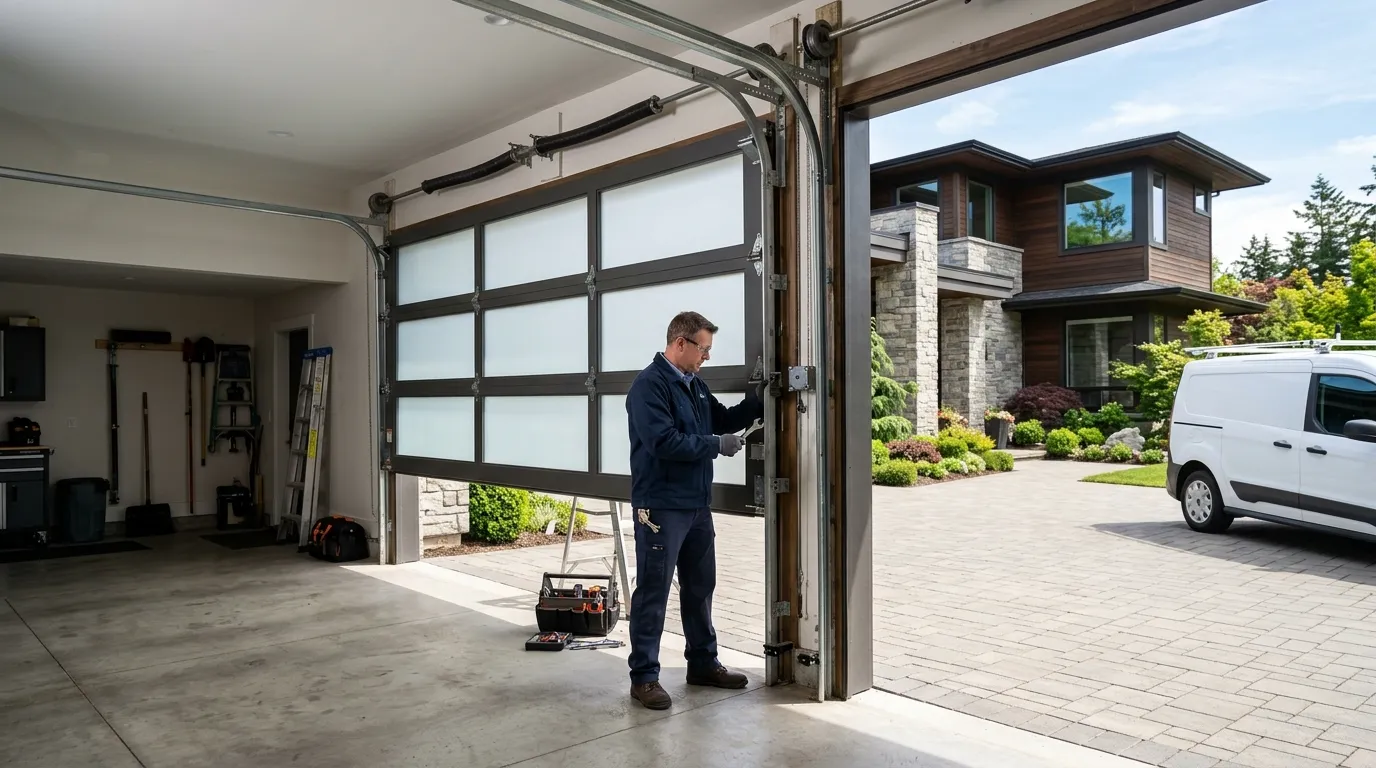
Redmond, WA · Garage Door Service
Silver Firs homes date mostly to 1997 - original springs and openers are now at failure age. Redmond Garage Door Pros covers repairs out to Silver Firs.
We don't have a Silver Firs-specific price list to hand you here, and we're not going to guess at one. What we can tell you is how the job usually shapes up in a neighborhood like this. Most houses went up around 1997, which means the springs, cables, and openers that came with the house are pushing close to 30 years old. That's past the point where a spring repair is a quick fix - by the time a torsion spring on a door this age lets go, the drum and bearing plate next to it are often worn enough that we're replacing more than just the spring. Median household income in Silver Firs runs about $153,026, noticeably above the $139,152 median across the wider service area, and in practice that shows up as more owners choosing a full opener swap over patching a 25-year-old chain drive once it starts grinding. We travel from Redmond to reach Silver Firs, so we're honest that this isn't a same-block dispatch - plan for a scheduled visit rather than someone showing up in twenty minutes. We'll give you the real number once we've looked at the door, not before.
One limitation worth saying plainly: if your opener is a discontinued model from the late 90s, the control board itself may not be stocked anywhere, and replacement beats repair on cost alone.
A door that reverses halfway up, a spring that let go with a bang, an opener that hums but doesn't lift - on a house built close to 1997, these are usually original parts finally giving out, not a fluke. Torsion springs are rated for a cycle count, and a door opened twice a day for 28 years has burned through most of that rating even in a house that's never had a hard bump or a dented panel. Rollers on original steel tracks from that era tend to be nylon-free plastic that's gone brittle rather than the sealed-bearing rollers used today, so a grinding or hopping motion on the way up often isn't the track being bent - it's rollers that have simply worn round on one side. Cables fraying near the bottom bracket show up more in this age bracket too, because galvanized cable from the 90s corrodes at a slower but steady rate even in our moderate-cold climate. If your opener is the original from construction, a slow close or a light that won't reset can be the logic board aging out rather than anything you did wrong.
With roughly 7,538 households in Silver Firs, most built inside a fairly narrow construction window, a lot of doors here came off the same handful of builder-grade product lines. That matters for how faults cluster: when one owner's spring goes at year 28, it's common for two or three houses on nearby streets to be within a year or two of the same failure, because the hardware, the cycle count, and the install date are all close together. Our winters here sit in the moderate-cold band rather than the hard freezes some regions get, so we don't see the extreme cold-snap spring snapping that colder climates report - but 28-year-old galvanized coating still loses its protection gradually, and once it's gone, the wire underneath corrodes at a normal rate regardless of how mild the winter was. The other common cause is simple: an opener installed in 1997 was never built with today's expected service life in mind, and most manufacturers stopped stocking parts for that generation years ago.
Because we run out of Redmond, about 13 miles from Silver Firs, we book these as scheduled jobs rather than instant walk-up calls. Tell us the age of the house if you know it and what the door is doing - grinding, refusing to close, reversing - and we can usually tell you over the phone whether it sounds like a spring, a roller set, or the opener board, which helps us bring the right parts on the truck instead of making a second trip. If the door came with the house and hasn't been touched since, say so; that's useful information because it tells us we're likely dealing with the whole original hardware set at once, not just the one part that failed loudest. We'll ask which side of the neighborhood you're on relative to the main road patterns, since it helps with routing when we've already got a stop nearby, but we don't hold a depot or crew stationed in Silver Firs itself - every visit is a dispatch from Redmond.
There's a real limit to what's safe to do yourself here, and torsion springs are the clearest example - the spring on a double door built in 1997 is wound under enough tension to break a hand or worse, and we don't recommend touching it without the right bars and clamps. What you can do safely: check whether the track bolts have worked loose (common after nearly 30 years of thermal expansion and contraction), clean and lightly lubricate rollers if they're original plastic ones showing wear, and test the auto-reverse safety feature by placing a block under the door and confirming it stops and backs up. If your opener predates the 1993 federal safety-sensor requirement, that's a signal on its own that it's due for replacement rather than repair, regardless of whether it still runs. When in doubt on anything spring-related, it's cheaper to have it looked at than to end up needing a hospital visit and a new door.
In Silver Firs, where most homes went up around 1997, it's common for the door hardware, springs, and even the opener to still be the originals. If nobody's mentioned a replacement, assume the spring is close to 30 years old and budget for it to need attention soon.
No. We run out of Redmond, about 13 miles away, and reach Silver Firs on scheduled visits rather than instant dispatch. Tell us what the door is doing when you call so we bring the right parts on the first trip.
A lot of Silver Firs went up in the same construction window, often with similar builder-grade hardware. Springs are rated by cycle count, so houses built around the same year tend to hit failure age within a year or two of each other.
If the opener predates the mid-90s safety-sensor standard, or parts for that model are no longer stocked, replacement usually costs less over time than chasing repairs on a board nobody makes parts for anymore.
Call now or request a free quote - same-day service on most repairs, upfront written pricing.