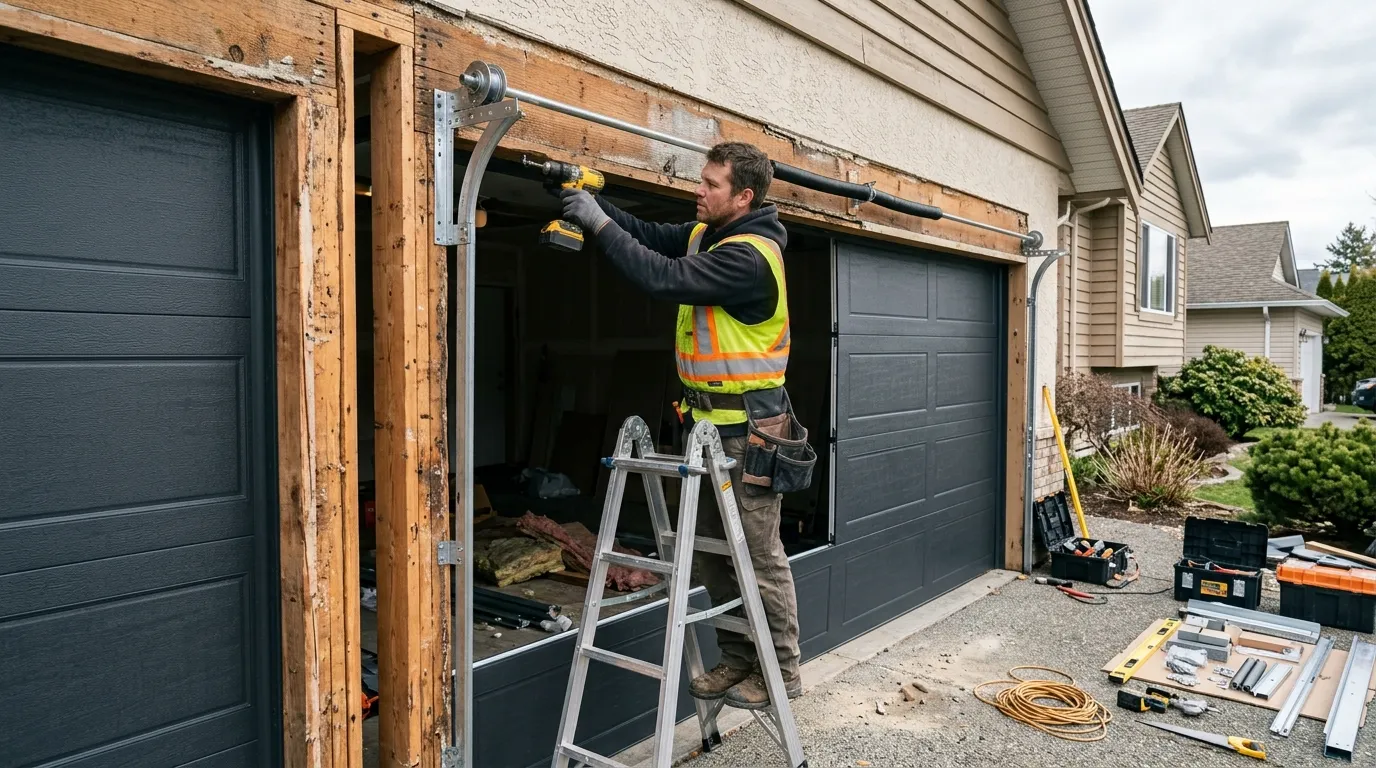
Redmond, WA · Garage Door Service
Panel replacement for Union Hill-Novelty Hill homes built mostly around 2001, four miles from our Redmond shop. Steel and insulated panels for newer stock, done right.
The median income in Union Hill-Novelty Hill runs $181,820, well above the $139,152 median across the wider service area, and that number matters for panel work specifically. When a door is only a few years past its prime and one section is dented or split, the math almost always favors fixing the section rather than replacing the whole door - and at this income level, homeowners here tend to make that call fast instead of living with a bent panel for a season. That said, panel swaps are not a weekend job for most people. You're unbolting hinges under spring tension, aligning a new section against panels that have weathered differently, and torquing hardware to spec so the door doesn't bind. If you've pulled a garage door track before and know what a torsion spring can do to a hand, some of this is within reach. If you haven't, the risk of a pinched cable or a door that runs crooked afterward isn't worth the money saved. We'll say plainly: this is a repair where a bad DIY attempt often costs more to undo than it would have cost to do right the first time.
Most houses in Union Hill-Novelty Hill went up around 2001, a good sixteen years newer than the 1985 median across the broader area we cover from Redmond. That later build date matters because doors from this era are far more likely to use steel panel sections in standard widths that manufacturers still stock, rather than the older wood or discontinued steel profiles you find on 1970s and '80s stock. The job itself starts with identifying the exact panel profile and finish - ribbed, flush, or a raised-panel look - since a mismatched section stands out immediately on a door this age, where the rest of the panels haven't faded or chalked the way an older door's would. From there it's removing the fastener strip, disconnecting the damaged section from its neighbors, fitting the replacement, and rehanging rollers and hinges so the door tracks true. On an insulated door, we also check that the new section's foam core matches the R-value of the rest of the door, since a mismatched core shows up as a cold spot in winter.
The most common snag on a 2001-era door isn't finding a panel - it's finding one that matches the exact color and texture after nearly two and a half decades of UV exposure and Pacific Northwest damp. Factory finishes on doors this age have usually mellowed a shade or two, and a brand-new section can look obviously newer even when the profile is a perfect match. We tell people this up front rather than let them discover it after installation. The other place this goes wrong is on doors with a discontinued insulated core - some builders in this area used proprietary panel systems in the early 2000s that aren't cross-compatible with today's standard stock, and a repair on those sometimes turns into a full door replacement once we're inside it. We won't know which situation applies until we look at the door in person; we don't guess sight unseen.
We don't quote panel replacement prices without seeing the door, since the cost swings on panel width, insulation type, and whether the section has to be special-ordered to match a discontinued profile. What we can say is that at the income levels typical of Union Hill-Novelty Hill, most homeowners choose a targeted panel swap over a full door replacement when the damage is limited to one or two sections and the rest of the door is sound - the math works in favor of the smaller job more often here than in areas with older, harder-to-match doors. If a door's core has degraded to the point that a new section won't seal properly against the old ones, we'll tell you that instead of selling a patch that won't hold. We travel to Union Hill-Novelty Hill from our Redmond shop, four miles away, for every job - there's no local depot, so scheduling runs through the same dispatch as the rest of the area.
This area sits in a cold-moderate climate band, which shows up in panel damage in a specific way: foam-core panels installed after 2000 hold up well against the cold itself, but the seams between panels are where trouble starts. Repeated freeze-thaw cycles work at the seal between sections, and over enough winters that seam can crack the panel skin along the fold line rather than in the middle of the panel - a different failure pattern than the dents and rust-through you see on older uninsulated steel doors. If you're seeing a hairline crack running along a horizontal seam rather than a dent from an impact, that's usually a cold-cycle fatigue crack, and it's a sign the door has been doing its job holding heat in rather than a manufacturing defect.
We stock standard steel panel sections in the widths most common to doors built through the early 2000s, along with insulated cores sized for the R-values used on doors from that period - the stock that actually matches what's on the ground in Union Hill-Novelty Hill. What we don't keep on the truck are proprietary or discontinued core systems from a handful of early-2000s builder-grade doors; those get special-ordered once we've confirmed the exact model, and that can add lead time to the job. We'd rather tell you a part needs to be ordered than install something close enough that it doesn't seal or match.
Not exactly, if your door is more than a few years old. Factory finishes fade and chalk over time, and a new panel starts out at full color. We can get close, but on a door pushing two decades old, some visible difference is normal until the whole door weathers evenly again.
Depends on the door's age and how the rest of it is holding up. If the core and other panels are sound, a single-section swap is usually the cheaper, faster fix. We'll look at the whole door before recommending either way - we don't push full replacements when a repair will hold.
No. We run out of Redmond, about four miles away, and travel to Union Hill-Novelty Hill for every job. There's no separate local branch or depot here.
On insulated doors installed in the last couple decades, the seam between panels flexes with temperature swings more than the panel face does. In a cold-moderate climate like this one, that seam is often where fatigue cracking shows up first, even without a direct impact.
Call now or request a free quote - same-day service on most repairs, upfront written pricing.